Neurological Disease
-
Neurological Disease Related Products (19360)
Related Products (19360)

-
Antibodies (42)
-
Related Compound Screening Libraries (7)
-
RKS262
 0 ImagesCat. No.: HY-113720CAS No.: 1041469-97-9
RKS262 is an orally active cyclin/CDK inhibitor. RKS262 is also an apoptosis inducer and cell cycle regulator, exhibiting cytotoxic activity against cancer cells. RKS262 induces caspase-3 cleavage, ROS generation, SAPK/JNK activation, and upregulates the expression of p53, Bid, Bad, Bok, and p27. RKS262 inhibits the expression of Bcl-2, Mcl-1, Bcl-xL, p21, cyclin D1, cyclin B1, cdc-2, cyclin D4, and DNA-pk KU-80 subunit. RKS262 suppresses the phosphorylation of the IGF-1R/PI3K/PKC pathway, ras oncogene activity, and Cdk-6, while increasing total Akt expression. RKS262 induces G2/M or S phase cell cycle arrest, disrupts mitochondrial transmembrane potential, and reduces tumor burden in xenograft models. RKS262 is used in research on neuroblastoma and ovarian cancer.
-
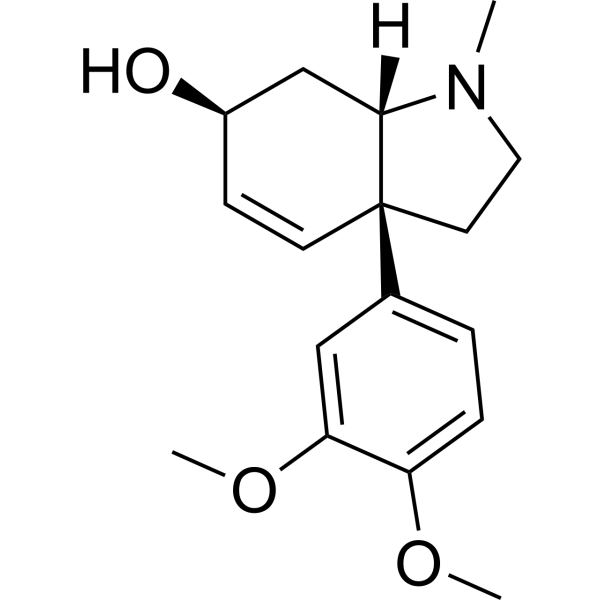
Mesembrenol
 0 ImagesCat. No.: HY-124482CAS No.: 25516-15-8
Mesembrenol is an alkaloid inhibitor of serotonin transporters and PDE4. Mesembrenol also inhibits glutamatergic AMPA receptors and can be used in research on mild to moderate depression.
-
Pramipexole (Standard)
 0 Images
Pramipexole (Standard) is the analytical standard of Pramipexole. This product is intended for research and analytical applications. Pramipexole is a selective and blood-brain barrier (BBB) penetrant dopamine D2-type receptor agonist, with Kis of 2.2 nM, 3.9 nM, 0.5 nM and 1.3 nM for D2-type receptor, D2, D3 and D4 receptors, respectively. Pramipexole can be used for the research of Parkinson's disease (PD) and restless legs syndrome (RLS).
-
GSK189254A hydrochloride
 0 ImagesCat. No.: HY-12200CAS No.: 945493-87-8Synonyms: GSK189254
GSK189254A hydrochloride is a novel, potent and selective histamine H3 receptor antagonist with pKi values of 9.59-9.90 and 8.51-9.17 for human and rat H3, respectively.

-
(S)-3-Keto sphinganine (d18:0) hydrochloride
 0 ImagesCat. No.: HY-172000CAS No.: 25515-53-1
(S)-3-Keto sphinganine (d18:0) hydrochloride is an intermediate in the biosynthesis of C18-Ceramide (HY-100355).
-
Samidorphan (Standard)
 0 ImagesCat. No.: HY-123689RCAS No.: 852626-89-2Synonyms: ALKS-33 (Standard); RDC-0313 (Standard)
Samidorphan (Standard) is the analytical standard of Samidorphan. This product is intended for research and analytical applications. Samidorphan (ALKS-33) is an orally active opioid system modulator that has a high affinity for binding with μ‐opioid, κ‐opioid, and δ‐opioid receptors. Samidorphan acts as an antagonist at μ‐opioid receptors and acts as a partial agonist at k-opioid and δ‐opioid receptors. Samidorphan primarily acts as an opioid receptor antagonist in vivo. Samidorphan can improve the behavior of depressed animals.
-
CLP257 (Standard)
 0 ImagesCat. No.: HY-110143RCAS No.: 1181081-71-9
CLP257 (Standard) is the analytical standard of CLP257 (HY-110143). This product is intended for research and analytical applications. CLP257 is a selective K+-Cl cotransporter KCC2 activator with an EC50 of 616 nM. CLP257 is inactive against NKCC1, GABAA receptors, KCC1, KCC3 or KCC4. CLP257 restores impaired Cl transport in neurons with diminished KCC2 activity. CLP257 alleviates hypersensitivity in rats with neuropathic pain. CLP257 modulates plasmalemmal KCC2 protein turnover post-translationally.
-
N-Boc norketamine
 0 ImagesCat. No.: HY-W718754CAS No.: 2177263-88-4
N-Boc norketamine is an arylcyclohexylamine.
-
7-Bromo-5-(2-fluorophenyl)-1,3-dihydro-3-hydroxy-2H-1,4-benzodiazepin-2-one
 0 ImagesCat. No.: HY-W781963CAS No.: 62659-65-8
7-Bromo-5-(2-fluorophenyl)-1,3-dihydro-3-hydroxy-2H-1,4-benzodiazepin-2-one is a metabolite of Flubromazepam.
-
BIP-135 (Standard)
 0 ImagesCat. No.: HY-111055RCAS No.: 941575-71-9
BIP-135 (Standard) is the analytical standard of BIP-135 (HY-111055). This product is intended for research and analytical applications. BIP-135 is a potent and selective ATP-competitive GSK-3 inhibitor, with IC50s of 16 nM and 21 nM for GSK-3α and GSK-3β, respectively. BIP 135 exhibits neuroprotective effect.
-
CTR/AMYR activator-1
 0 ImagesCat. No.: HY-185234CAS No.: 3068779-36-9
CTR/AMYR activator-1 (S configuration of compound 122) is a CTR/AMYR activator. CTR/AMYR activator-1 can be used in the research of bone diseases, metabolic diseases, cardiovascular diseases, and neurodegenerative diseases.
-
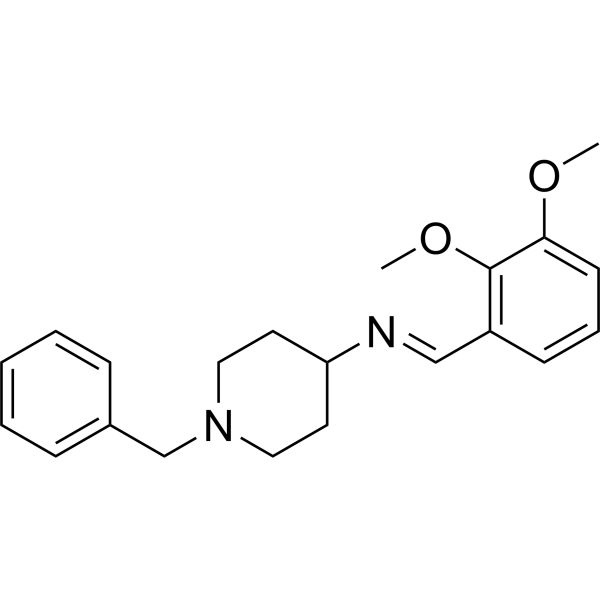
SEW06622
 0 ImagesCat. No.: HY-160037CAS No.: 261349-28-4
SEW06622 is a BACE-1 inhibitor with an IC50 value of 6.3 μM and can be used in Alzheimer's disease research.
-
7-PET
 0 ImagesCat. No.: HY-179319CAS No.: 13965-63-4
7-PET is a μ-opioid receptor agonist that can be used in the research of psychiatric disorders.
-
Carmagerol
 0 ImagesCat. No.: HY-170703CAS No.: 140396-81-2
Carmagerol is a phytocannabinoid metabolite.
-
XE991 (Standard)
 0 ImagesCat. No.: HY-108577ARCAS No.: 122955-42-4
XE991 (Standard) is the analytical standard of XE991 (HY-108577A). This product is intended for research and analytical applications. XE 991, a Kv7 (KCNQ) channels blocker, potently inhibits Kv7.1 (KCNQ1), Kv7.2 (KCNQ2), Kv7.2 + Kv7.3 (KCNQ3) channel, and M-current with IC50s of 0.75 μM, 0.71 μM, 0.6 μM, and 0.98 μM, respectively.
-
Tetrahydrocannabivarin acetate
 0 ImagesCat. No.: HY-168362CAS No.: 885123-57-9Synonyms: 1-Acetyl-△9-THCV
Tetrahydrocannabivarin acetate (1-Acetyl-△9-THCV) is structurally similar to known phytocannabinoids.
-
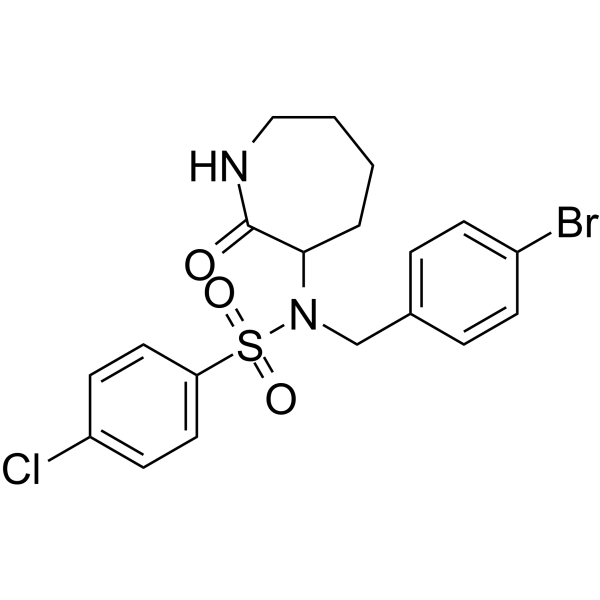
ELN318463 racemate
 0 ImagesCat. No.: HY-50882ACAS No.: 851599-82-1
ELN318463 racemate is the racemate of ELN318463. ELN318463 is an amyloid precursor protein (APP) selective γ-secretase inhibitor. ELN318463 shows differential inhibition of presenilin (PS1)- and PS2-comprised γ-secretase with EC50s of 12nM and 656 nM for PS1and PS2, respectively. ELN318463 is 51-fold more selective for PS1.
-
JYL-79
 0 ImagesCat. No.: HY-117922CAS No.: 289902-64-3
-
AMG-628
 0 ImagesCat. No.: HY-W931056CAS No.: 862269-93-0
AMG-628 is an orally active inhibitor for TRPV1, that inhibits Capsaicin (HY-10448) or acid (pH 5)-induced Ca2+ influx into TRPV1- expressing CHO cell with IC50 of 4.9 and 3.1 nM. AMG-628 exhibits analgesic activity in Capsaicin (HY-10448)-induced rat model, and exhibits a half-life of 2.4 h in rats.